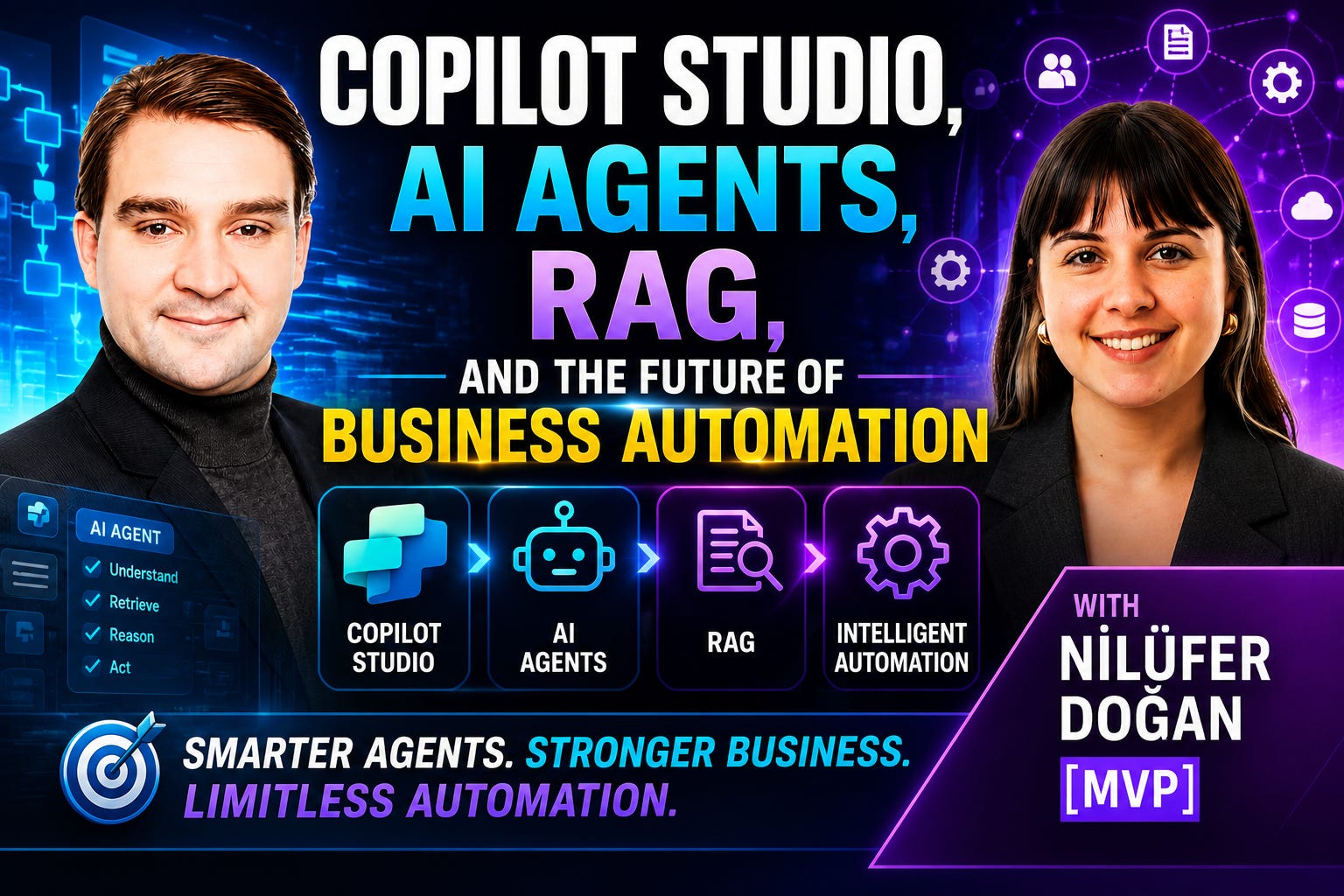
IAEA Expert: Building Enterprise AI with Copilot Studio
The landscape of enterprise technology is shifting beneath our feet. As organizations move beyond simple automation and into the era of generative intelligence, Microsoft Copilot Studio has emerged as a central pillar for business transformation. In a recent episode of the M365.FM Podcast, Nilüfer Doğan, a platform specialist at the International Atomic Energy Agency (IAEA), shared her journey from an economics background to becoming a leading architect of AI solutions.
The conversation highlights a critical turning point: we are no longer just building chatbots that follow rigid scripts. We are building intelligent agents capable of reasoning, deciding, and automating complex business processes. For organizations looking to move from AI experimentation to real-world value, understanding this evolution is essential.
From Economics to Low-Code: A Unique Path to AI
Nilüfer Doğan’s journey into the world of the Power Platform and AI is proof that the future of technology belongs to those who can bridge the gap between business logic and technical execution. Despite graduating with a degree in economics, her interest in data science and statistics led her to an internship at BSH Home Appliances, where she first encountered the potential of low-code tools.
“I realized that I really loved what Power Apps and Power Automate do... because I was very interested with UI and instead of just doing hard code things, I was into just doing something simply and writing little code,” Nilüfer explains. This background in economics and statistics provides a unique edge in the AI space, allowing her to approach problem-solving with an analytical mindset focused on data structure and business outcomes rather than just the code itself.
Debunking the “Chatbot” Misconception
One of the biggest hurdles for organizations today is the lingering belief that Copilot Studio is simply a tool for building traditional chatbots. Nilüfer points out two major misconceptions that often lead projects astray:
The “Magic Button” Fallacy: Many believe that simply writing a few instructions will result in a perfect agent. In reality, a high-performing agent requires a carefully constructed foundation of knowledge, tools, and automation.
The Wrong Tool for the Job: Not every business problem requires an AI agent. Sometimes, the solution is better served by a Power App, a Power Pages site, or a simple Power Automate flow.
The true power of Copilot Studio lies in its ability to act as an orchestrator. It isn’t just about answering questions; it’s about connecting to data sources and triggering actions that solve specific “pain points” within an organization.
The Evolution: From Chatbots to Autonomous Agents
The industry is currently witnessing a massive shift in how we define conversational AI. Nilüfer breaks down the fundamental difference between the traditional systems of the past and the agents of the future:
Traditional Chatbots
Traditional chatbots are essentially manual decision trees. Developers have to define every single step, every possible turn in a conversation, and every logic gate. If a user steps outside of that predefined path, the chatbot fails. It is a static experience.
AI Agents
AI agents, powered by Copilot Studio and Azure AI, operate on a different plane. Instead of a rigid map, you provide the agent with instructions and goals. “In AI agents, it can decide based on what we give to those agents,” says Nilüfer. By describing the desired outcome and providing the right tools, the agent uses generative intelligence to determine the best path to fulfill the user’s request.
Why Enterprises are Racing to Adopt AI Agents
There is a palpable sense of urgency in the corporate world regarding AI. Nilüfer attributes this to two main factors. First, there is the “AI Trend”, the realization that the “AI train” is leaving the station and organizations must jump on board to remain competitive. Second, and more importantly, there is the realization of operational efficiency.
Enterprises are burdened by manual, repetitive tasks. By implementing intelligent agents, they can automate these processes, freeing up human capital for more strategic work. This isn’t just about novelty; it’s about the fundamental digital transformation of internal processes.
Choosing Your Path: Copilot Studio vs. Azure AI
A common question for architects is when to use the low-code environment of Copilot Studio versus the high-code flexibility of Azure AI (such as Azure OpenAI or AI Search). Nilüfer suggests a strategic approach to this decision:
Start with Copilot Studio: For most M365-centric business scenarios, Copilot Studio should be the first stop. Its integration with the existing ecosystem makes it the fastest route to value.
Scale to Azure for Complexity: When dealing with massive, unstructured datasets or highly specific custom requirements, it may be necessary to move to the Azure side.
The Hybrid Approach: Often, the best solutions are a mix. For example, using Azure AI Search to index large volumes of data and then surfacing that information through a Copilot Studio agent.
Real-World Impact: The Confluence Agent Case Study
To illustrate the practical application of these technologies, Nilüfer shared a scenario involving the integration of Confluence. In this case, the goal was to help employees navigate a vast internal knowledge base. The solution required indexing documents from an on-premise Confluence instance using Azure tools and then wrapping that functionality into an agent that could provide concise, accurate answers to user queries.
This highlights the “Knowledge + Tools + Automation” framework. By connecting the agent to the right knowledge source (Confluence) and using the right tools (Azure Indexing), the agent becomes a highly valuable internal resource rather than just a basic chat interface.
Key Takeaways for IT Leaders and Developers
Based on the insights shared in the conversation, here are the actionable steps for those looking to master Copilot Studio:
Focus on Prompt Engineering: The quality of your agent is directly tied to the quality of your instructions. Learn to describe roles, goals, and constraints clearly.
Audit Your Data: AI is only as good as the data it accesses. Ensure your knowledge sources are structured and accessible before building.
Empower Citizen Developers: Like Nilüfer’s work at the IAEA, mentoring non-technical staff to build their own agents can accelerate digital transformation across the entire organization.
Iterate and Refine: Don’t expect perfection on day one. The evolution of Copilot Studio means new features are arriving constantly; stay agile and be prepared to update your agents as the platform grows.
Conclusion
The future of Copilot Studio is not just about “chatting”, it is about agency. As Nilüfer Doğan’s experience shows, the transition from economics to AI development is a testament to the accessibility and power of the Microsoft ecosystem. By moving away from rigid chatbots and toward flexible, intelligent agents, organizations can unlock unprecedented levels of productivity.
Whether you are a seasoned developer or a curious IT leader, the message is clear: the tools are ready, the platform is evolving, and the opportunity to redefine how your organization works is here. It’s time to stop building simple bots and start building the future of automation.


