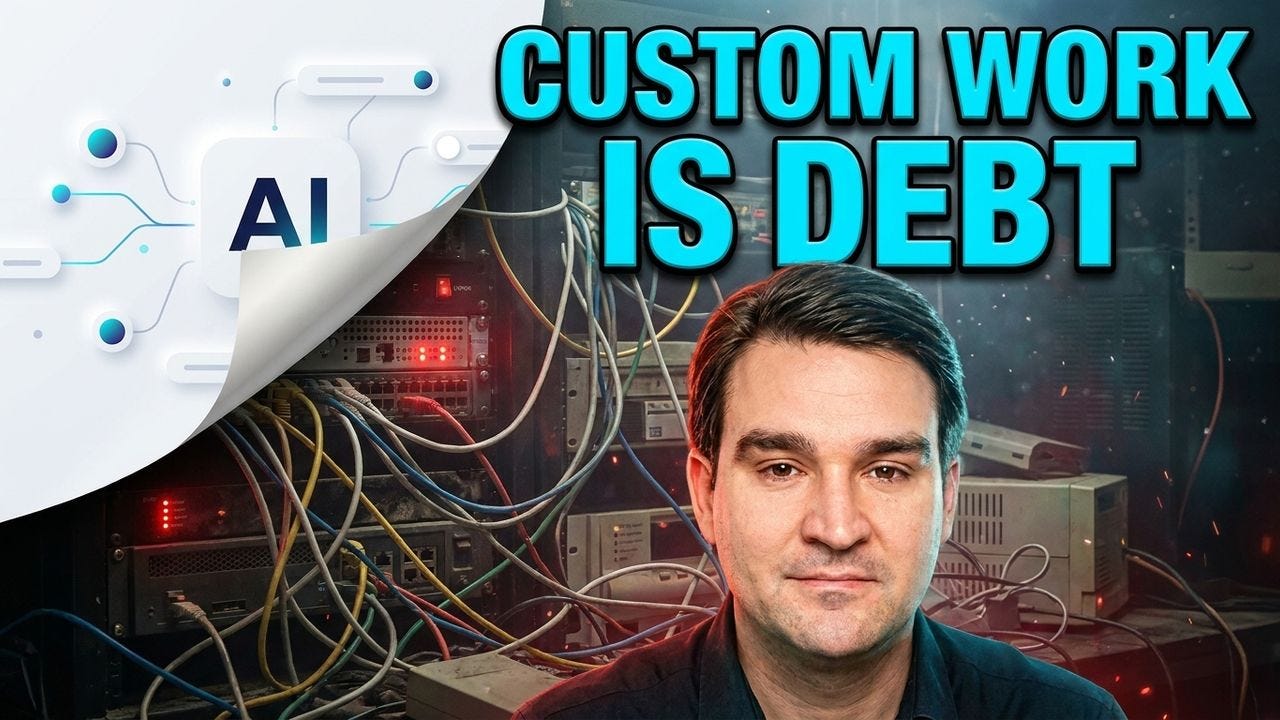
Stop thinking of Dataverse as just a place to store your rows and columns. That assumption is officially broken. For years, we’ve treated Dataverse like a standard database, but we are witnessing a massive, fundamental shift in the technology landscape. Dataverse is no longer just a repository; it is evolving into an orchestration layer, a context engine, and the connective tissue between your organization’s collective knowledge and the AI systems of the future.
Most organizations haven’t noticed this shift yet. They are still operating under the legacy mindset of building custom API wrappers to connect systems, just as they did five years ago. But in an AI-driven world, that model doesn’t just slow you down, it creates a bottleneck that can paralyze your digital transformation. Today, I want to show you why the old way of integrating is becoming your biggest liability and how a new standard is changing everything.
The Legacy Model: Why Custom Integration Became Technical Debt
If we look back 20 years, integration was a straightforward (if difficult) problem. You had your ERP, your CRM, and perhaps a legacy mainframe. They didn’t talk to each other, so developers built bridges. We wrote API wrappers, added error handling, and implemented retry logic. At the time, this was a pragmatic and necessary solution. It worked for point-to-point communication.
However, this model has a structural flaw that is now being exposed by AI: Every new system requires new code.
By 2024, the average enterprise has accumulated hundreds of these custom integrations. It wasn’t intentional; it was “integration sprawl.” One team needed Salesforce data, so they built a connector. Another team needed Salesforce connected to ServiceNow, so they built another. The result is a web of custom code where:
Maintenance costs are astronomical: Organizations are often spending 300% of the original build cost just to keep these integrations running over a two-year period.
Knowledge walks out the door: When the developer who wrote the custom Python script or PowerShell task leaves, the knowledge of how that integration works leaves with them.
Security is a black hole: Security teams can’t govern what they can’t see. Finding where customer data flows through a dozen undocumented wrappers can take weeks of “code archaeology.”
This model breaks completely when you try to connect one system to 50 different AI tools that change their interfaces every quarter. You simply cannot move fast enough if you are stuck maintaining a pile of legacy wrappers.
Enter the Model Context Protocol (MCP)
So, what is replacing the old way? It’s something called the Model Context Protocol (MCP). To be clear: MCP isn’t a database or a traditional API. It is a standardized way for AI systems to discover and use the tools you already have.
Introduced in late 2024 by Anthropic and rapidly adopted by industry giants like OpenAI, Google, Microsoft, and Amazon, MCP was created because every major AI vendor realized they were facing an infrastructure nightmare. They needed a standard to prevent total chaos.
The USB-C of AI
Think of MCP like USB-C. Before USB-C, every device, your phone, your laptop, your camera, needed a specific, proprietary cable. It was a mess. USB-C provided a single standard plug that works for everything. MCP is doing exactly that for AI and enterprise software.
Under the hood, MCP uses a lightweight protocol (JSON-RPC) that allows an AI client (like Claude or ChatGPT) to connect to a server and automatically “see” what tools are available. The AI immediately understands:
What the tool does.
What parameters it needs.
What the data schema looks like.
What the safety and security boundaries are.
This solves the “discovery” problem. You no longer need to write custom code to tell an AI how to talk to your data; the protocol makes the data self-describing.
Dataverse as a First-Class AI Citizen
This is where things get exciting for Power Platform and Dynamics 365 users. Microsoft has built a dedicated Dataverse MCP server. This means Dataverse is no longer a static silo; it is a first-class citizen in the global MCP ecosystem.
When Dataverse is MCP-enabled, any AI agent, whether it’s Claude, GitHub Copilot, or a custom GPT, can connect to it and instantly understand your business logic. It doesn’t just move data from point A to point B; it provides context. The AI knows which operations are safe to perform and which data it has permission to access. This allows you to move at the speed of AI while staying completely safe within your established governance framework.
Key Takeaways for Your Organization
The shift from “Database” to “Context Engine” is happening now. If you want to stay ahead, here is what you need to consider:
Audit Your Integration Debt: Stop viewing custom connectors as “just infrastructure.” Recognize them as liabilities that carry a heavy maintenance tax.
Standardize on Protocols, Not Wrappers: Move away from point-to-point API wrappers. Look toward standardized protocols like MCP that allow for broader AI interoperability.
Leverage Dataverse as an Orchestration Layer: Stop treating Dataverse as a place to dump data. Start using it to define the tools, permissions, and context that your AI agents need to be effective.
Prioritize Discovery and Governance: AI needs to know its own boundaries. Use the self-describing nature of MCP to ensure your AI systems are governed, audited, and safe.
Conclusion: The Future is Contextual
The era of manual, point-to-point integration is ending. We are moving into a world where AI doesn’t just “access” data, it understands it. By transforming Dataverse from a simple database into a robust context engine through the Model Context Protocol, you are setting your organization up for a future where AI can act with precision and safety.
Don’t get left behind performing “code archaeology” on old API wrappers. Embrace the shift, simplify your architecture, and turn your data into the powerful orchestration layer it was always meant to be. The future of AI is built on context, and that context lives in your Dataverse.


